 Shiba inu
 controls are chosen and verified by the SHIB state they change
Updated on
Choose the Shiba inu control by the state you need to change: Send transfers SHIB to another address, Approve grants a spender an allowance, Swap exchanges tokens and Bridge moves supported assets between networks. Record the network, balances, allowance and quote before signing. A passing result is the expected receipt plus the specific state change, not a button confirmation or wallet notification.
Choose Send, Approve, Swap or Bridge by the state each control changes, then compare the receipt with the recorded starting state.
Control choice begins with the state that should change
Use the narrowest control that matches the intended outcome. Choose Send when another address should receive SHIB. Use Approve when a particular contract needs permission to spend it. Select Swap for an exchange and Bridge when the balance must appear on another supported network.
A rejected request does not automatically justify a different control. If the wallet never broadcast the transaction, review the request and its network before trying again. If the transaction reached the network and failed, inspect its receipt first. A failed swap may need a fresh quote, while an allowance problem needs an approval. Increasing slippage cannot repair an incorrect spender, destination or network.
Balance controls and permission controls create different records
Each control has its own acceptance condition. Comparing the observed change with the wrong record can make a valid action look incomplete or a failed action look successful.
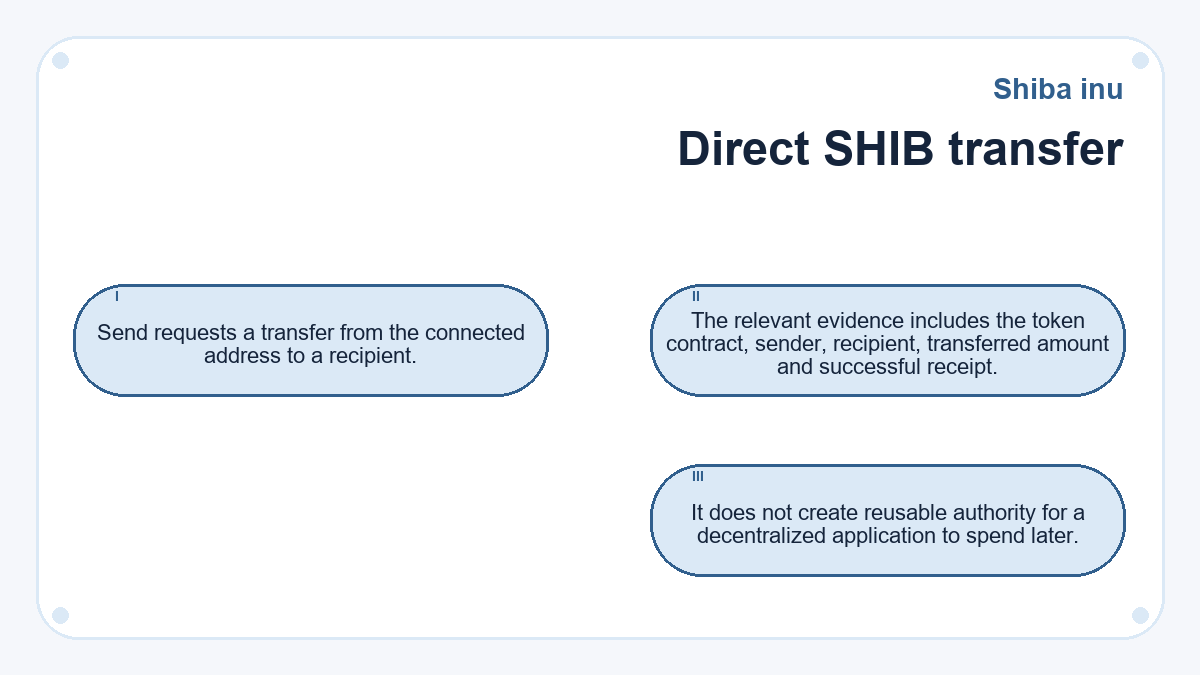
Direct SHIB transfer
Send requests a transfer from the connected address to a recipient. The relevant evidence includes the token contract, sender, recipient, transferred amount and successful receipt. It does not create reusable authority for a decentralized application to spend later.
SHIB spender allowance
Approve writes an allowance for a named spender. The owner still holds the SHIB until that spender uses the permission through a later contract call. For an approval, verify the spender address and allowance amount; the recipient field belongs to a direct transfer.
Token swaps and bridge transfers
Swap combines an input token, output token, amount and execution limits. Bridge uses a source network, destination network and supported asset path. Reversing a direction selector changes the requested operation, but the selection itself produces no on-chain state until the wallet submits a transaction.
Direct SHIB transfers need ownership evidence
SHIB is an ERC-20 token issued on Ethereum. A direct transfer calls the token contract and requires the network’s native asset for gas. Record the sender’s SHIB balance, recipient address, amount and network before signing. A wallet preview can catch an unintended destination, but it does not prove execution.
After confirmation, check the receipt status and the corresponding token transfer record. The sender and recipient balances should reflect the executed amount, subject to any other activity involving those addresses. A successful transfer to a deposit address proves delivery to that address. It does not by itself prove that a custodial service has credited an internal account, because that credit is a separate system event.
What does an approval actually permit?
An approval changes spending permission without moving SHIB when the transaction confirms. An ERC-20 approval authorizes a named spender to draw up to the recorded allowance from the owner’s token balance. Review both the amount and spender because the application name shown by a wallet is not the permission stored by the token contract.
A limited approval caps the available permission at the selected amount. A maximum approval, when offered, can leave a much larger permission available after one action. Confirmation should change the allowance for that exact owner, spender and token contract while leaving the SHIB balance unchanged; gas is paid separately in the network’s native asset.
Reducing or revoking an allowance creates another transaction. Setting it to zero removes future ERC-20 spending authority after confirmation, but it cannot reverse a transfer or swap that already executed. Transaction ordering matters when a spending transaction and revocation remain pending at the same time.
Swap settings define the acceptable execution
A SHIB swap passes only when the executed trade remains within the limits accepted in the signed request. The visible quote is a proposal based on pool state at that moment. It can change before execution as reserves, routing or the selected input changes.
Amount and direction
The input field states what the trader offers, while the output field identifies what the route should return. Reversing direction changes which token, if any, needs an allowance. A Max control may assign the available token balance as input, but the wallet still needs a separate native-asset balance for gas.
Slippage and deadline
Slippage tolerance limits how far execution may move against the quoted result before the swap reverts. It does not promise that the displayed quote will remain available. The deadline supplies a separate time boundary. A transaction executed after that boundary should fail even if the allowance and token balance remain sufficient.
Minimum received, price impact and route
For an exact-input swap, minimum received is the output floor enforced by the transaction. Price impact estimates how the proposed trade changes the pool price, while the route identifies the pools used to reach the output token. These fields answer different questions. Raising slippage lowers the protected output floor; it does not reduce price impact or change the liquidity provider fee that the pool charges.
The executed output, receipt status and final balances provide pass-fail evidence. An approval receipt alone is insufficient because approval and swapping are separate state changes. If the swap fails, the allowance may remain available even though no exchange occurred.
Bridge controls require evidence from two networks
The bridge direction determines which network locks or releases value and which network receives the corresponding balance. A deposit to Shibarium locks tokens on Ethereum and mints the corresponding pegged tokens on Shibarium. Reversing the direction invokes a withdrawal path rather than undoing the deposit in place.
Before signing, record the source network and balance, the destination network and selected asset. After submission, save the bridge transaction identifier. Ethereum-side actions require ETH for gas, while Shibarium transactions use BONE. A successful source transaction is one checkpoint. Destination completion is another, so the destination balance and bridge status must agree before the action passes.
Token support belongs to the route, not merely to a familiar symbol. If the interface does not admit the selected asset and direction, changing the amount cannot create compatibility. The available control changes only when the live bridge configuration supports that path.
A bounded retry for a rejected SHIB swap
Consider a SHIB exact-input swap that was rejected while the starting SHIB balance remained unchanged. The next action depends on the active network, the SHIB allowance granted to the swap router and a fresh quote. The smallest safe response addresses the failed condition instead of changing every setting.
- Keep the intended input token, output token and network unchanged while identifying the failed condition.
- Compare the requested SHIB input with the allowance granted to the router specified in the swap request.
- If the quote expired or its output floor could not be met, request a new quote before changing the tolerance.
- If the allowance was insufficient, approve only the amount needed for the intended input.
- Submit one revised swap and retain its hash, receipt status and resulting token balances.
The retry passes when the swap receipt succeeds, the executed output respects the signed minimum and the two token balances show the expected exchange. An unchanged SHIB balance after a failed receipt is evidence that the token exchange did not occur, although the failed transaction may still have consumed native gas.
A transaction receipt separates submission from execution
A transaction hash identifies transaction data, but it does not prove that the network mined the transaction or that execution succeeded. The receipt supplies the execution status, block context, gas use and logs needed to distinguish a confirmed state change from a reverted call.
Receipt status and logs
A successful ERC-20 transfer normally includes a Transfer event with the token contract, sender, recipient and amount. An approval produces an Approval event and an updated allowance. A reverted transaction keeps the attempted call in network history but reverses its token state changes. The sender can still pay native gas for the computation that failed.
Resulting balances and permissions
Read the state that belongs to the chosen control after checking the receipt. A send should alter SHIB ownership. An approval should alter the spender allowance. A swap should change the input and output balances within its execution limits. A bridge requires source and destination evidence because its completion spans two networks.
Later transactions can change those values again. For that reason, compare the receipt with state at the relevant block or with a starting record captured immediately before the action. A current balance viewed much later may combine the intended action with unrelated transfers.
Wallet displays need network and contract context
A wallet can hide a valid balance when the token is not listed, the wrong network is active or cached data has not refreshed. It can also show the same symbol for unrelated token contracts. A useful record therefore pairs the account address with the network and token contract instead of relying on the ticker alone.
Adding a token display changes presentation, not ownership. Likewise, switching the visible network does not move SHIB or cancel a pending transaction on the previous network. When a displayed value conflicts with a receipt, inspect the on-chain balance for the same address, contract and network that the transaction used.
When should the control change after a failed transaction?
The control should change only when the failure evidence points to a different missing state or prerequisite. An insufficient allowance calls for Approve, while an expired swap deadline calls for a new quote and transaction. Neither issue is repaired by sending SHIB to the application contract.
Insufficient native gas concerns the network’s fee asset, not the SHIB allowance. A wrong destination calls for stopping before submission because a successful transfer does not include an ERC-20 undo control. An unsupported bridge direction requires a supported route rather than a larger amount or looser swap setting.
Some wallet rejections occur before broadcast. They produce no transaction hash and no on-chain change, so the existing balances and allowances remain the baseline. A mined failure creates a receipt and may consume gas, but reverted token changes should not appear in the final state.
Configuration changes reset the evidence baseline
Changing the network, spender, bridge direction, swap route, amount, deadline or slippage tolerance creates a new request with different acceptance conditions. Capture a fresh quote and relevant state before signing it. Evidence from the earlier request can explain the change, but it cannot prove that the revised action passed.
The correct control changes when the intended state changes or the live interface no longer supports the selected configuration. Until then, retain the same goal and alter only the condition that the receipt or state record identified as failing.
What to know about Shiba inu
Does changing the swap direction cancel an existing SHIB allowance?
No. Changing swap direction edits the proposed input and output, but it does not alter an allowance already recorded on-chain. That allowance remains tied to its owner, SHIB token contract and spender until it is consumed, replaced or revoked. If SHIB becomes the output token, the earlier SHIB allowance may be irrelevant to the new swap while still remaining active.
Do I need ETH or BONE to reduce a SHIB allowance?
You need the native gas asset of the network where the allowance exists. An Ethereum allowance transaction uses ETH for gas, while an allowance recorded on Shibarium requires BONE. Reducing or setting the allowance to zero is an on-chain transaction, so the wallet must hold enough native gas even though the permission concerns SHIB.
When can a bridge deposit require a second status check?
A bridge deposit needs another check when the source transaction succeeds before the destination balance appears. Source confirmation proves that the deposit call executed on its network, but destination issuance has its own completion state. Match the bridge record with the destination address, network and token balance before treating the cross-network movement as complete.
How does a partial SHIB allowance affect an exact-input swap?
An allowance below the requested SHIB input cannot authorize the router to transfer the full input. The interface may request another approval, or the swap can revert if it reaches execution without enough permission. A larger SHIB balance does not repair that mismatch. Compare the requested input with the allowance for the exact router address used by the quote.
Can lowering a SHIB allowance undo a completed swap?
No. Lowering an allowance changes future spending authority and does not reverse a finalized swap. If a reduction and swap are both pending, their execution order can affect the outcome: a reduction confirmed first may leave the swap without enough permission, while a swap confirmed first can use the allowance that existed at its execution time.